How to Build a Balanced Plate at Every Meal: Protein, Fiber, Fats and Hand Portions
Build a balanced plate at every meal: half vegetables and fruit, a quarter protein, a quarter whole grains, healthy fats, and easy hand portion cues.
Key takeaways
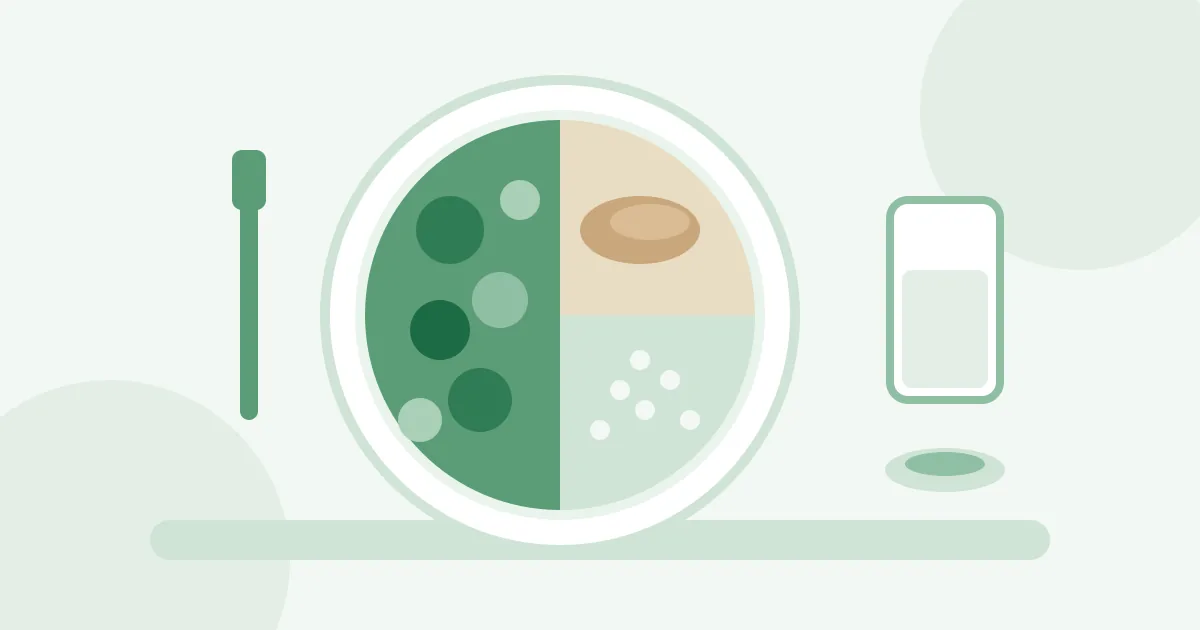
- A simple balanced plate is about half vegetables and fruit, a quarter protein foods and a quarter whole grains or other fiber rich starches, plus a little healthy fat and water to drink, as shown in Harvard's Healthy Eating Plate.
- Protein matters at every meal: the 2025 to 2030 Dietary Guidelines for Americans set a goal of 1.2 to 1.6 grams of protein per kilogram of body weight per day for adults.
- Fiber comes mostly from vegetables, fruit, beans, lentils and whole grains. WHO advises adults to get at least 25 grams of naturally occurring fiber and at least 400 grams of fruit and vegetables a day.
- Healthy fats are part of a balanced plate in small amounts: about 2.5 to 5 teaspoons of added healthy fats a day, mainly unsaturated oils, nuts, seeds, avocado and oily fish.
- Your hand is a handy portion guide: the British Heart Foundation suggests a palm for a portion of starchy food or fruit and vegetables, slightly less than a palm for protein, and two fingers for cheese.
- You do not need a perfect plate every time. Aim for the right balance over the day and the week, and adjust portions for your size, hunger and activity.
Most people do not need a complicated diet plan. They need a simple way to put a good meal together, again and again, without counting every calorie or weighing every gram. That is exactly what the balanced plate gives you: a picture you can hold in your head at home, at work, in a canteen or at a restaurant.
This guide explains how to build a balanced plate at every meal. You will learn what goes in each part of the plate, how much protein, fiber and fat you are aiming for, and how to judge portions using nothing more than your hand. Every number comes from public health sources such as the World Health Organization, the US Dietary Guidelines, Harvard's Healthy Eating Plate and the British Heart Foundation.
The short answer
A balanced plate for most adults looks like this:
- Half the plate: vegetables and fruit. Choose a variety of colors. Potatoes go in the starchy quarter, not here.
- A quarter of the plate: protein foods. Fish, poultry, eggs, beans, lentils, tofu, lean meat or yogurt. About a palm sized portion.
- A quarter of the plate: whole grains or fiber rich starches. Brown rice, oats, whole wheat pasta or bread, quinoa, barley, or potatoes with the skin.
- A little healthy fat. Olive or canola oil for cooking, a few nuts or seeds, some avocado or oily fish.
- Water to drink. Or coffee and tea with little or no sugar.
This layout comes from Harvard's Healthy Eating Plate, which recommends making about half your meal vegetables and fruits, a quarter whole grains and a quarter healthy protein, using healthy plant oils in moderation and drinking water, tea or coffee. Harvard notes that the sections show approximate proportions, not fixed calorie amounts, because people's needs differ by age, sex, body size and activity.
Why the plate method works
The plate method is popular with dietitians and public health bodies because it solves the hardest part of eating well: turning advice into an actual meal. You do not have to remember numbers for every nutrient. You just look at your plate.
It also nudges you toward the things most people lack. The World Health Organization notes that many people do not eat enough fruit and vegetables or get enough dietary fiber, while eating more highly processed foods high in unhealthy fats, free sugars and salt. Filling half your plate with vegetables and fruit tackles both problems at once: it adds fiber, vitamins and minerals, and it leaves less room for the foods you want to eat less often.
Finally, it is flexible. WHO describes four principles of a healthy diet: adequacy, balance, moderation and diversity, and says the exact make up of a healthy diet varies with age, sex, activity, culture and locally available foods. The plate works with a Mediterranean dinner, a rice and curry lunch, a bean chili, a stir fry or a sandwich and salad. You keep your own food culture and simply adjust the proportions.
Part 1: Fill half the plate with vegetables and fruit
Vegetables and fruit are the foundation of a balanced plate. WHO advises everyone over 10 years of age to aim for at least 400 grams of fruit and vegetables a day. The British Heart Foundation suggests that eating more than the minimum, around 7 to 8 portions a day, can boost fiber, vitamin and mineral intake without many extra calories.
How to make the vegetable half easy
- Aim for two or more vegetables per meal. For example, roasted carrots and green beans, or a salad plus steamed broccoli.
- Use frozen and canned vegetables. MedlinePlus, summarizing the 2025 to 2030 Dietary Guidelines, lists frozen, dried and canned fruit and vegetables with little or no added sugar as good options, and WHO agrees as long as they are low in added sugar and sodium.
- Mix vegetables into the main dish. Add spinach to pasta sauce, peppers and onions to eggs, or grated zucchini to chili.
- Count fruit as part of the half, especially at breakfast. Berries on oatmeal or a sliced apple with yogurt fill the produce half of a breakfast plate.
- Go easy on juice. Harvard suggests limiting juice to a small glass a day, and the BHF suggests limiting fruit juice and smoothies to 150 ml a day.
What counts as a serving
MedlinePlus lists these examples of one serving under the 2025 to 2030 Dietary Guidelines: 1 cup (about 100 grams) of raw or cooked vegetables, 2 cups of raw leafy greens, 1 cup of raw fruit or a quarter cup of dried fruit. Most adults are advised to eat roughly 1 1/4 to 4 or more servings of vegetables and 1 to 2 1/2 servings of fruit a day, depending on age, sex and activity.
A note on potatoes
Harvard's Healthy Eating Plate does not count potatoes toward the vegetable half, because of their impact on blood sugar. That does not make potatoes bad food. Simply move them to the starchy quarter of your plate, keep the skin on, and choose baked, boiled or roasted over fried.
Part 2: Give a quarter of the plate to protein
Protein helps build and repair muscle and other tissues, keeps you full and supports training. The 2025 to 2030 Dietary Guidelines for Americans put more emphasis on protein than earlier editions and set a goal of 1.2 to 1.6 grams of protein per kilogram of body weight per day for adults, adjusted to calorie needs. For a 70 kg (154 pound) adult, that is about 84 to 112 grams a day, which works out at roughly 28 to 37 grams per meal across three meals.
Our full guide to how much protein you need explains daily targets for different goals and ages in detail. For building a plate, you only need to remember: a palm sized portion of a protein food at every main meal.
Good protein choices
| Protein food | One serving (MedlinePlus, 2025 to 2030 guidelines) | Why it fits a balanced plate |
|---|---|---|
| Fish and seafood | 3 ounces (85 g) cooked | Oily fish such as salmon, sardines and trout provide omega 3 fats |
| Poultry or lean meat | 3 ounces (85 g) cooked | High quality protein; choose lean cuts and skinless poultry |
| Eggs | 1 egg | Quick, cheap and easy to add to any meal |
| Tofu, tempeh or seitan | 3 ounces (85 g) | Plant protein that takes on any flavor |
| Beans or lentils | 1/2 cup (113 g) cooked | Protein and fiber in one food |
| Nuts or seeds | 1 ounce (28 g) | Protein plus healthy fats |
| Peanut butter | 2 tablespoons | Easy protein for breakfast or snacks |
Harvard advises choosing fish, poultry, beans and nuts most often, limiting red meat and cheese, and avoiding processed meats such as bacon and cold cuts. WHO also notes that for many adults a shift toward more plant based protein can bring health benefits, particularly when it replaces red meat. MedlinePlus adds a target of about 8 ounces (225 grams) of cooked seafood a week.
Beans and lentils do double duty
Beans, peas and lentils count as protein and as vegetables. Half a cup of cooked lentils gives about 7.8 grams of fiber according to the Dietary Guidelines food sources list, along with a good dose of protein. A bean chili, a lentil curry or a chickpea salad can cover your protein quarter and much of your fiber needs in one dish.
Part 3: Fill the last quarter with whole grains or fiber rich starches
Starchy foods give you energy, especially if you are active. The key is the type. Harvard's Healthy Eating Plate recommends whole and intact grains, such as whole wheat, barley, quinoa, oats and brown rice, because they have a milder effect on blood sugar and insulin than white bread, white rice and other refined grains. Harvard also stresses that the type of carbohydrate matters more than the amount.
MedlinePlus, summarizing the new US guidelines, says most adults should eat about 2 to 4 servings of whole grains a day, where one serving is, for example, 1 slice of whole wheat bread, 1/2 cup of cooked oats, or 1/2 cup of cooked brown rice or quinoa. It also notes that if you replace vegetables with starches you can still gain weight, even when the starches are whole grain, which is a good reason to keep this part to about a quarter of the plate.
Easy swaps:
- brown rice instead of white rice;
- whole grain pasta instead of regular pasta;
- whole wheat bread or wraps instead of white;
- oatmeal instead of a sugary cereal;
- air popped popcorn instead of chips as a snack.
If you train hard or have a very active job, you may need a bigger starch portion than a quarter of the plate. That is fine. Scale the starchy part up on training days and keep the vegetable half in place.
Fiber: the nutrient that ties the plate together
Fiber does not have its own section on the plate because it comes from three of them: vegetables and fruit, beans and lentils, and whole grains. WHO advises everyone over 10 years of age to get at least 25 grams of naturally occurring dietary fiber a day.
That sounds like a lot until you see how quickly real foods add up. The chart below uses the official Dietary Guidelines list of food sources of fiber.
A single balanced day might look like this: oatmeal with a cup of raspberries at breakfast, a lentil and vegetable bowl at lunch, an apple in the afternoon, and salmon with broccoli and bulgur at dinner. Using the figures above, that easily passes 25 grams of fiber without any supplements.
If you are eating very little fiber now, increase it over a couple of weeks and drink enough water, which helps your gut adjust. Our guide to how much water you should drink has simple ways to do that. For easy swaps, meal ideas and a step by step plan, see our guide on how to eat more fiber every day.
Healthy fats: a small but important part of the plate
Fat is essential. WHO points out that two fatty acids, linoleic acid and alpha linolenic acid, can only come from the diet. The question is the type and the amount.
- Choose mostly unsaturated fats. WHO lists unsaturated fats in fish, avocado, nuts and sunflower, soybean, canola and olive oils as preferable to saturated fats in fatty meat, butter, palm and coconut oil, cream, cheese, ghee and lard.
- Keep saturated fat below 10% of daily energy. Both WHO and the 2025 to 2030 Dietary Guidelines use this limit.
- Avoid industrially produced trans fats. WHO says they are not part of a healthy diet.
- Use added fats in small amounts. MedlinePlus, summarizing the new US guidelines, says most adults should get about 2.5 to 5 or more teaspoons (10 to 25 ml) of healthy fats a day, and reminds readers that protein foods, dairy, nuts and avocados already contain fat.
On the plate, that usually means a teaspoon or two of olive oil for cooking or dressing, a small handful of nuts or seeds sprinkled on top, a few slices of avocado, or choosing oily fish as your protein. Harvard also notes that "low fat" does not automatically mean healthy, so there is no need to fear a drizzle of good oil.
Use your hand to judge portions
You do not need scales or measuring cups to build a balanced plate. The British Heart Foundation describes your hands as "a simple, reliable way to measure food". Here is how the BHF portion guide translates to your plate. Portions are a starting point, not a rule: to get better at knowing when your plate is enough, see our guide to reading your hunger and fullness cues. And if you want a reason to keep most plates built from whole foods, a November 2026 review linked junk food heavy diets in young people with poorer mood and learning; read what the research found about junk food and brain health.
| Food group | Hand cue (British Heart Foundation) | How it looks on a balanced plate |
|---|---|---|
| Starchy carbohydrates | About the size of the palm of your hand | One palm of rice, pasta, potatoes or bread for most meals |
| Protein foods (not dairy) | Slightly smaller than the palm of your hand | One palm of chicken, fish, tofu, beans or eggs |
| Fruit and vegetables | About the size of the palm of your hand per portion | At least two vegetable portions to fill half the plate |
| Cheese | About the size of two fingers | A small amount grated or sliced on top |
| Oils and spreads | 1 to 2 teaspoons, depending on the fat | A drizzle of oil or a thin spread of butter |
A few practical points:
- Your hand grows with you. Larger people tend to have larger hands and higher energy needs, so the cues scale roughly with body size. They are still approximations, not exact rules.
- The BHF figures are daily portion counts, not per meal targets. For example, the BHF suggests around 8 portions of starchy carbohydrate a day for women and 10 for men on average, and 4 to 5 portions of protein foods. On a single plate, one to two palms of starch and one palm of protein is a sensible starting point for most adults.
- Adjust for hunger and activity. If you are still hungry, add more vegetables first. If you train hard, add more starch and a bit more protein on training days.
Example balanced plates for every meal
The same pattern works at breakfast, lunch and dinner. Here are some easy examples.
| Meal | Half: vegetables and fruit | Quarter: protein | Quarter: whole grains or starch | Healthy fat |
|---|---|---|---|---|
| Breakfast | Berries and a sliced banana | Plain Greek yogurt or two eggs | Oatmeal or whole grain toast | A spoon of nuts or seeds |
| Lunch | Mixed salad plus roasted peppers and zucchini | Chickpeas or grilled chicken | Quinoa or a whole wheat wrap | Olive oil and lemon dressing |
| Dinner | Steamed broccoli and carrots | Baked salmon | Brown rice or potatoes with skin | The natural oils in the salmon |
| Plant based dinner | Spinach, tomatoes and onions | Lentil curry | Bulgur or brown rice | Cooking oil, plus a few cashews |
| Quick sandwich lunch | Side salad and an apple | Tuna, egg or hummus filling | Whole grain bread | A little avocado |
Breakfast
Breakfast is where many people lack protein and vegetables. A simple fix is to add a protein food you like, such as yogurt, eggs or cottage cheese, and a portion of fruit. Vegetables at breakfast, such as tomatoes, spinach or mushrooms with eggs, are a bonus.
Lunch
If lunch is often rushed, batch cooking helps. Our guide to meal prepping healthy lunches for the week uses the same plate formula: one protein, one whole grain, two vegetables and a sauce, cooked once and packed into five containers. When lunch or dinner is at a restaurant, the same plate formula still works; our guide on how to eat healthy at restaurants shows how to order for it in different cuisines.
Dinner
Dinner is often the easiest meal to balance, because you usually have more time. Start with the vegetables, not the meat or pasta, and build the rest of the plate around them.
Bowls, soups and mixed dishes
Not every meal comes on a plate. Harvard suggests using the same proportions when you cook a soup, stew or bowl: make about half the ingredients colorful vegetables and the rest a mix of whole grains and a healthy protein such as beans. A chili with plenty of peppers, onions and tomatoes, beans and a little lean meat, served with brown rice, fits the plate perfectly even though it sits in a bowl.
What to drink with a balanced plate
Harvard's Healthy Eating Plate places a glass of water beside the plate and recommends water, tea or coffee with little or no sugar, limiting milk and dairy to 1 to 2 servings a day and juice to a small glass. WHO advises keeping free sugars below 10% of daily energy, which is about 50 grams or 12 level teaspoons a day for an adult eating around 2,000 calories, and notes that fruit juices count as free sugars. Sugary drinks are one of the easiest places to cut back.
How the balanced plate fits the new US Dietary Guidelines
The 2025 to 2030 Dietary Guidelines for Americans encourage eating minimally processed whole foods and discourage highly processed foods such as packaged snacks, sugary drinks and frozen dinners. They group healthy eating into protein, dairy, vegetables, fruits and whole grains, with healthy fats included in small amounts. The balanced plate turns that advice into one picture: protein and whole grains each take a quarter, vegetables and fruit take half, and dairy and healthy fats fit around the edges.
Our article on the 2025 to 2030 Dietary Guidelines explains what changed in the new guidance and what it means for everyday eating.
Common mistakes when building a balanced plate
Starting with the starch. It is easy to fill half the plate with pasta or rice and then squeeze vegetables in. Serve the vegetables first.
Forgetting protein at breakfast and lunch. Many people eat most of their protein at dinner. Spreading it across the day makes it easier to reach the daily goal and helps you stay full.
Counting fries and potato chips as vegetables. Harvard does not count potatoes as vegetables, and fried potatoes add a lot of fat and salt. Keep them as an occasional starch.
Drowning a good plate in sauce. Creamy dressings, butter and cheese can add more fat and salt than the rest of the meal. Use them in small amounts, and remember that WHO advises adults to keep salt below 5 grams a day.
Aiming for perfection. The BHF reminds readers that you do not need to get the balance right with every meal. Try to get it right over a day or even a week.
Making it a habit
A balanced plate becomes automatic with a little repetition. Keep frozen vegetables, canned beans, eggs, oats and a whole grain in the house so you can always build a decent plate in minutes. Use a smaller plate if portions tend to get out of hand; the BHF notes that a standard portion can look small on a large plate and suggests a smaller plate to avoid overloading.
Pair good meals with good movement. Regular activity and strength work help you use the protein and carbohydrate on your plate well; our guides to how much exercise you need and strength training for beginners show how to get started.
The bottom line
To build a balanced plate at every meal, fill half the plate with vegetables and fruit, a quarter with protein and a quarter with whole grains or other fiber rich starches, add a small amount of healthy fat, and drink water. Use your hand as a guide: a palm of starch, slightly less than a palm of protein, and at least two palms of vegetables. Aim for at least 25 grams of fiber and 400 grams of fruit and vegetables a day, and spread protein across your meals. Get it right most of the time, not every time, and the plate will do the rest. Explore more practical guides in our areas of expertise.
This article is general information, not medical or individual nutrition advice. If you have a medical condition, are pregnant or have specific dietary needs, talk to your doctor or a registered dietitian.
Frequently asked questions
What does a balanced plate look like?
A balanced plate is roughly half vegetables and fruit, a quarter protein foods such as fish, poultry, eggs, beans, lentils or tofu, and a quarter whole grains or other fiber rich starches such as brown rice, oats or whole wheat pasta. Add a small amount of healthy fat, such as olive oil, nuts or avocado, and drink water, coffee or tea with little or no sugar.
How much protein should be on my plate?
Most adults do well with a palm sized portion of protein food at each main meal. The 2025 to 2030 Dietary Guidelines for Americans set a daily goal of 1.2 to 1.6 grams of protein per kilogram of body weight, adjusted to your calorie needs. Spreading that across three meals usually means roughly 25 to 35 grams of protein per meal for many adults.
How can I measure portions without a scale?
Use your hand. The British Heart Foundation suggests that a portion of starchy carbohydrate or of fruit and vegetables is roughly the size of your palm, a portion of protein is slightly smaller than your palm, a portion of cheese is about the size of two fingers, and a portion of oil or spread is 1 to 2 teaspoons. Hand sizes vary, so treat these as practical guides rather than exact measures.
Do potatoes count as vegetables on a balanced plate?
On Harvard's Healthy Eating Plate, potatoes do not count toward the vegetable half because of their effect on blood sugar. Treat potatoes as part of the starchy quarter of your plate, keep the skin on for extra fiber, and fill the vegetable half with other vegetables.
How much fiber should I eat a day?
The World Health Organization advises adults to aim for at least 25 grams of naturally occurring dietary fiber a day. Most of it comes from vegetables, fruit, beans, lentils, nuts, seeds and whole grains. Half a cup of cooked lentils alone provides about 7.8 grams, according to the Dietary Guidelines food sources list.
Does every meal need to be perfectly balanced?
No. The British Heart Foundation notes that you do not need to achieve the right balance with every meal and can aim for it over a day or even a week. Use the plate as a default for main meals and fill gaps with snacks such as fruit, yogurt, nuts or raw vegetables.
Sources
- Harvard T.H. Chan School of Public Health, The Nutrition Source: Healthy Eating Plate
- MedlinePlus (US National Library of Medicine): Dietary Guidelines for Americans 2025 to 2030
- US Department of Health and Human Services and US Department of Agriculture: Dietary Guidelines for Americans, 2025 to 2030
- Dietary Guidelines for Americans: Food Sources of Dietary Fiber (standard portions)
- World Health Organization: Healthy diet fact sheet (January 2026)
- British Heart Foundation: Portion sizes, everything you need to know (updated July 2025)
This article is general information about exercise and healthy living, not medical advice. If you have a health condition, an injury or are pregnant, talk to a doctor or qualified professional before changing your activity.


